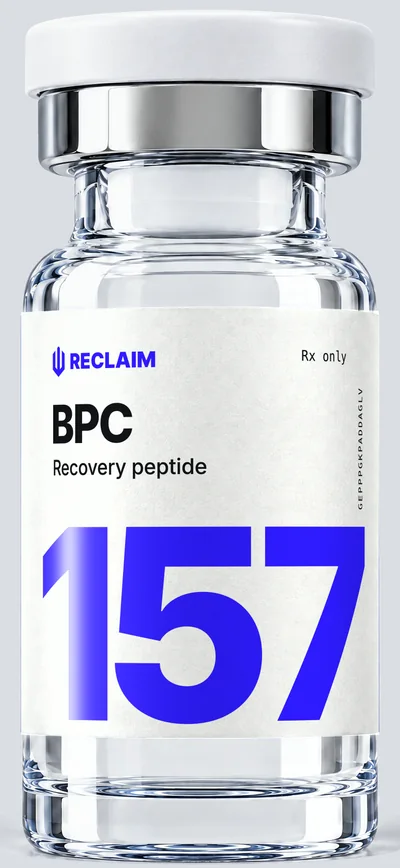
Stop training around the pain. BPC-157 is the recovery peptide studied for over 30 years for how the body repairs tendons, ligaments, muscle and bone. Prescribed online by a licensed U.S. provider. Not a research chemical.
One peptide. Studied for the whole body you train.
Joints
A joint is only as steady as the tendons and ligaments around it, where BPC-157 is studied most.
Animal studies
Tendons
Studied in Achilles injury and in the cells that rebuild tendon.
Rat + cell studies
Ligaments
Studied for healing the MCL, the ligament on the inside of the knee.
Rat studies
Muscle
Studied for how injured muscle repairs and gets its function back.
Rat studies
Bone
Studied for how a gap in a long bone fills in with new bone.
Rabbit studies
Blood flow
Healing runs on blood supply. Studied for growing new blood vessels.
Lab + rat studies
Inflammation
Studied for how the body settles inflammation after an injury.
Animal studies
Gut lining
Where it started: first studied for the stomach and gut lining.
Animal studies
Based on lab and animal research; studies in people are still limited. BPC-157 isn’t FDA-approved, results vary, and your provider decides if it’s right for you.
Sound familiar?
The pain you’ve learned to train around.
Rest. Ice. Ibuprofen. Repeat. If the same spot has bothered you for months, there’s a reason: tendons and ligaments get far less blood than muscle, so they heal slowly.
Train through it
Knees
Every step down
Knees that ache on the stairs, on every run and every squat.
Shoulders
Every overhead press
A shoulder that fights every press, every throw, every reach.
Tendons
The first steps
An Achilles or elbow that’s stiff every single morning.
Recovery
Sore for days
One hard session, and the rest of the week pays for it.
Pick the pain, then drag the line. This is the comeback BPC-157 is built for.
BeforeAfter
Dramatization · models, not patients
01 / 04
Knee pain
Before
Every step down the stairs hurts. Squats are off the table, and runs end early.
After
Taking the stairs two at a time. Back under the bar, back out on the road.
What BPC-157 is studied for
In people: a 2021 review of 16 patients who had BPC-157 injected into the knee found that 14 reported less knee pain. In rats, it’s studied for healing the knee’s MCL ligament.
Lee & Padgett, Altern Ther Health Med, 2021 · 16 patients, no control group · Cerovecki et al., J Orthop Res, 2010 · rat
02 / 04
Shoulder pain
Before
A shoulder that fights every press, every throw and every reach for the top shelf.
After
Pressing overhead again, with a shoulder you trust.
What BPC-157 is studied for
In tendon cells, BPC-157 helped the cells that rebuild tendon grow out, migrate and survive, the work a rotator cuff depends on.
Chang et al., J Appl Physiol, 2011 · cell study
03 / 04
Elbow pain
Before
Tennis or golfer’s elbow: a forearm that burns on every grip, every swing, every handshake.
After
Back on court, swinging through every serve.
What BPC-157 is studied for
In tendon cells, BPC-157 raised growth hormone receptor levels, which may make the cells more responsive to growth hormone.
Chang et al., Molecules, 2014 · cell study
04 / 04
Achilles pain
Before
An Achilles that’s stiff every morning and angry after every run.
After
Running the long way home, the whole way.
What BPC-157 is studied for
In a rat study, BPC-157 sped up healing of a cut Achilles tendon.
A diagnosis comes first: see a doctor for any new, severe or worsening injury. BPC-157 doesn’t replace medical care or rehab, most of its research is in animals, and it isn’t FDA-approved.
Why it heals so slowly
Tendons are starved for blood. BPC-157 is studied for exactly that.
Illustration: a torn tendon, new blood vessels growing in and repair cells moving to the tear
01
Low blood flow
Tendons and ligaments get far less blood than muscle. Less blood means fewer repair cells, which is why they’re some of the slowest tissue in the body to heal.
02
New blood vessels
In lab and rat studies, BPC-157 activated VEGFR2, a key switch for growing new blood vessels, and sped up the return of blood flow to injured tissue.
Hsieh et al., J Mol Med, 2017
03
Repair cells on the move
In tendon-cell studies, BPC-157 helped the cells that rebuild tendon grow out, migrate and survive, and raised their growth hormone receptors.
Chang et al., J Appl Physiol, 2011 · Molecules, 2014
Keep moving
Train like you used to.
Start with a free online visit. A licensed U.S. provider decides if BPC-157 is right for you, and you’re only charged if you’re prescribed.
In a 2021 review from a U.S. clinic, 16 patients with knee pain had BPC-157 injected into the knee, four of them alongside thymosin beta-4. When the clinic followed up, 14 said their pain had improved.
Lee & Padgett · Alternative Therapies in Health and Medicine · 2021
A small, retrospective review with no control group, and the injections went into the joint, not under the skin. It’s an early signal, not proof, and results vary.
for your online visit with a licensed U.S. provider
100%
prescribed. Never sold as “research use only”
The research, straight
30+ years of research. Here’s what it actually says.
Most BPC-157 research is lab and animal work, much of it from one research group in Zagreb, Croatia. It’s promising, and it isn’t proof. We’d rather you hear that from us.
1990s
Origins
First described
Researchers in Zagreb describe BPC, a peptide based on a protein found in human gastric juice.
LabEarly papers
1999
Bone
Bone defect healing
Studied for how a segmental gap in a long bone heals.
RabbitBone
2003
Tendon
Achilles tendon
Cut Achilles tendons healed faster in treated rats, and tendon cells grew faster in the lab.
Rat + cellsJ Orthop Res
2008
Muscle
Muscle injury
Studied for muscle repair and function after a crush injury.
RatSurg Today
2010
Ligament
Knee ligament (MCL)
Studied for healing of the medial collateral ligament of the knee.
RatJ Orthop Res
2011
Tendon cells
Repair cells
Helped tendon cells grow out, migrate and survive under stress.
CellsJ Appl Physiol
2014
Tendon cells
Growth hormone receptors
Raised growth hormone receptor levels in tendon cells.
CellsMolecules
2017
Blood flow
New blood vessels
Activated VEGFR2 and sped up blood-flow recovery in an injured limb.
Rat + cellsJ Mol Med
2019
Review
The big picture
A review of the muscle, tendon and ligament research: positive in animals, not yet confirmed in people.
ReviewCell Tissue Res
Summaries simplified. Lab and animal results don’t always carry over to people, and these studies don’t show that BPC-157 treats any condition.
Built for rehab
Do the rehab. Give it backup.
BPC-157 doesn’t replace your physio or your program. It’s the peptide studied for the tissue repair underneath them.
01
Get it diagnosed
A new, severe or worsening injury needs a doctor first. Then tell your Reclaim provider what’s going on.
02
Do the work
Your physio, your program, your load. BPC-157 is studied for the tendon, ligament and muscle repair underneath it.
03
Get back to it
The runs, the lifts, the games. Your care team is a message away the whole way back.
Only charged if a provider prescribes. Cancel anytime. Compounded medications are not FDA-approved.
How it works
From online visit to your door.
1. Tell us what’s going on
A few questions about your training, your injuries and your health. No insurance, no waiting room.
2. A provider reviews it
A licensed U.S. provider reviews your visit and prescribes BPC-157 only if it’s right for you. You’re only charged if you’re prescribed.
3. It ships to your door
Your BPC-157 ships free in discreet packaging. Message your care team any time.
In every box
Your BPC-157 vial
Ultra-fine needles
Alcohol pads
Step-by-step guide
Dosing calendar
FAQ
Questions, answered.
BPC-157 is a peptide, a short chain of 15 amino acids, based on a protein found in human gastric juice. Reclaim’s BPC-157 is prescribed by a licensed U.S. provider after an online visit and made for you by a state-licensed U.S. pharmacy.
Tendons, ligaments, muscle and bone, and also blood-vessel growth, inflammation and the gut lining. Most of that research is in the lab and in animals. Studies in people are still limited, so results aren’t guaranteed.
It’s the question everyone asks. BPC-157 is studied for the repair behind the pain: tendons, ligaments, muscle and bone, mostly in animals. In one small 2021 review of 16 people with knee pain who had BPC-157 injected into the knee, 14 reported improvement. There are no large trials in people yet, so results vary and nothing is guaranteed. Your provider will tell you straight whether it makes sense for you.
Yes, and that’s how most people think about it: your rehab does the work, and BPC-157 is studied for the tissue repair underneath it. Tell your physical therapist and your provider what you’re taking.
For any new, severe or worsening injury, yes. Get it diagnosed first: some injuries need imaging, a brace or surgery. Your Reclaim provider reviews your history before prescribing anything.
Peptides sold as “research use only” aren’t made or labeled for people, and there’s no way to know what’s really in the vial. Ours is prescribed for you after a provider review and made by a state-licensed U.S. pharmacy.
A small injection under the skin with an ultra-fine needle, on the schedule your provider sets. Your box comes with a step-by-step guide and a dosing calendar.
No. It’s a peptide, a short chain of amino acids. It isn’t a hormone or an anabolic steroid.
No. It’s compounded for you by a state-licensed U.S. pharmacy when a provider prescribes it. Compounded medications are not FDA-approved.
BPC-157 is on the World Anti-Doping Agency’s prohibited list. If you’re drug-tested, talk to your provider before you start.
Your provider goes over possible side effects, such as irritation where you inject, and reviews your health history before prescribing. You can message your care team any time.
No. The online visit is free, and you’re only charged if you’re prescribed.
Yes, anytime from your account.
Your body isn’t done yet.
Free online visit. A licensed U.S. provider decides if BPC-157 is right for you.